Sticks & Stones – News & Views from Christensen's Plant Center

Christensen’s Employee “Whys”

I tell people all of the time that I'm like an annoying toddler, asking "Why?". "Why? Why? Why?" 

Part of "adulting" is being gainfully employed. There are bills to pay, possibly a family to support. If we're lucky, we find a job we enjoy going to everyday (or at least most days). The ideal is to find an industry you can call home, whether or not you stay with the same employer. I was curious why my fellow Christensen's employees worked here and why they work in the industry. So I sent them all a short survey to ask "Why?"

Sometimes the "why" is as simple as Larry's "I needed a job". Other "whys" included expected answers. But there were also some unique stories. Can you relate to any of them?

Like many of you, some of Christensen's employees have been in the industry a long time. As expected, owner Eric has been around since the age of 12. But so has Matt (with a break in his 30s). Kim, Barry and Cinco provided similar answers with 40+ years, 40 years and 45 years respectively. Chris and Dave are close behind with around 30 years. Christensen's also has the relative newcomers like Jen who's in her second season with the company, but has been in the industry for seven.

When asked why they're in the landscaping/green industry, there was a common thread that many employees enjoy the outdoors. Barry agreed, adding "the industry is still fun. Problem solving and meeting some of the most interesting people" were reasons he's stayed.

Molly explained that it was her love of the outdoors and plants (more specifically perennials) that brought her to the industry. "Working outside was what got me hooked. Weeding, watering, trimming plants, and working on my farmer's tan, was so peaceful and relaxing which is so different from most jobs. Working in the office was the next step for me. But I stay for those moments where I can walk out to the lot and see all of the beautiful perennials that I now order."

The plants are, of course, an important element. Chris said "I like working with the plants and seeing all the new varieties that come out." 

One of the more unique stories was Jen's. She was laid off from a hospital during COVID and was hired at a neighborhood nursery. "I always liked plants, but truly came to love them. I look forward to the insanity that comes with spring time in a nursery. I take a lot of satisfaction in adding to the sustainability of our planet and helping people solve problems all while adding beauty around them."

According to a recent survey, 76% of employees with close friends at work are far more likely to stay with the organization. Another study reveals that most workers see friendships as a critical factor in their decision to remain at a company. In the fight to retain key talent, fostering meaningful relationships could be a game changer. (Leveraging Social Capital by Michael Arena)

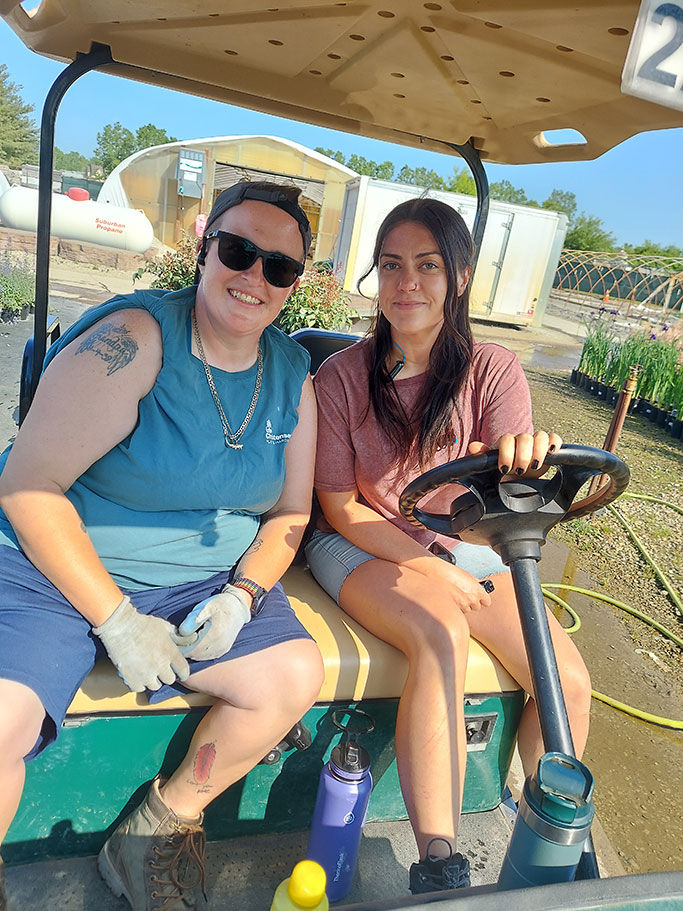
Co-workers, and friends, Alex and Britt

Kim's experience seems to support that survey. She likes plants but essentially "stumbled" into the landscaping industry. She stayed because of Christensen's. "Christensen's takes very good care of their employees and the employees take very good care of each other."

Another employee reported similar feelings. "I'm not sure why I stayed, maybe I'm a masochist. But something about the place and people really resonated with me. I liked that it wasn't retail and I enjoy doing blue collar work."

"Relationships I've built over the years stand out the most" for Matt. He went on to say, "It's the people. We move thousands (even millions) of dollars in products around, yet most of us understand this industry is full of SNAFUs and unpredictability. Success comes from working as a team, staying ahead of problems, managing expectations, and celebrating the small wins along the way. At its core, this industry is about picking things up and putting them back down again. But it's how we work together to make that happen, while creating more beautiful spaces and providing for our families, that I reflect on."

Christensen's owner, Eric, had planned to fly planes. He even went to school at Embry-Riddle in Arizona to study Aeronautical Science. But he realized he loved flying too much to make it his career believing "your career shouldn't be your passion." So he returned to grow and sustain the family business intending to one day take it over.

As for me, I'm in this job because I needed a part-time position that would work around my kids' schedule and Christensen's needed part-time help for the buyers. But, after almost 7 seasons, I've come to enjoy learning about the plants, using the resources to alter my own landscaping and being surrounded by so much natural beauty.

Technology Tools for Hardscape

It's Sunday morning and stores aren't open yet. You're still in your pajamas anyway. So you go online to shop for a new piece of furniture. But it's so difficult to visualize that new chair, couch or side table in your living room. Wait, there's a button that says "Show Me" or "Try It In Your Space". Suddenly, a picture of that sofa appears on your screen with the instructions to point your device where you want to "place" it. 

Augmented reality is a fun tool. It allows you to "try before you buy", saving money and hassle.

It's also an opportunity for you, as a business owner or project manager/sales person. But who has the resources to develop that kind of technology? The hardscape vendors you buy from through Christensen's have done the work for you. They've developed everything from project galleries to augmented reality. What have you used from this list?

Unilock has developed an app, Uview.

Its augmented reality capabilities allow you to plan more than just a flat patio: add kitchens, fire pits and more. Visit your favorite app store to download.


In addition to Uview, Unilock's technology tools include UVision® 3D Landscape Creator, an online design program as well as Speed-Calc™, a mobile friendly project calculator.


Techo-Bloc also has an augmented reality program. Visit their website to find the right product, see how colors work in the space, all from your phone or device. Inspiration and planning guides are also available.

Contractors can find technical information, training information and even chat with a design expert as part of Techo-Bloc's Contractor pages.

Oaks Landscape Products provides several inspirational opportunities. The Oaks Landscape Project Gallery includes 5 pages of image projects. Their website also has an extensive list of technical information and guides in their Resource Center. You can find it on their website on the top ribbon. Find the Landscape Project Gallery and more under the Inspiration drop-down menu on the top ribbon.

High Format offers over a dozen Inspiration Galleries on their website, each with detailed pictures and specs of the products used in the project. Downloads are also available, providing project details as well as links to an Outcropping Layout App and Outcropping Height Guide Tool.

Dream Trip to the Netherlands

52 years of dreaming about seeing the tulips!

I'd heard of the gardens in the Netherlands most of my life: the colors, the amazing variety of flowers. I dreamed of being there!

Then I chose a seasonal, spring-dependent career and devoted many years to that beautiful business. Supporting my clients and my staff (that had become used to eating regularly) required time, toil, worry, and stress!  But how rewarding to know that Christensen’s had (indirectly) planted thousands upon thousands of perennials, shrubs and trees over the span of my work-life.

Then came the day I decided to exit Christensen’s. To this day, I struggle to say "retired". But, the nursery was well established, the staff very competent and experienced. It was time.

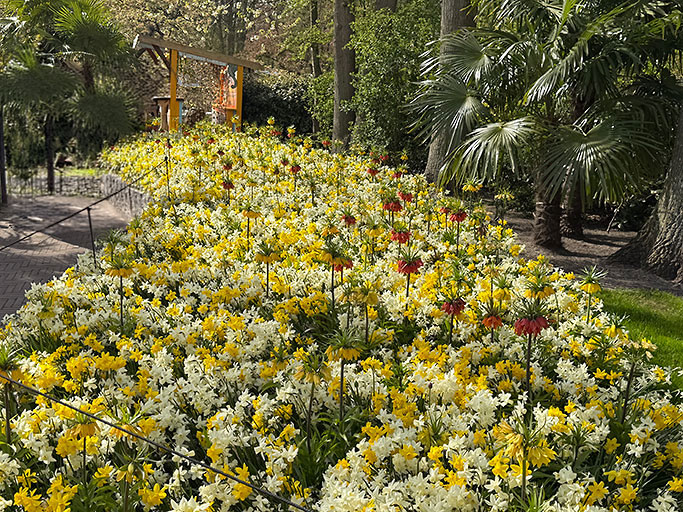
Retirement allows my wife, Penny, and I to thoroughly enjoy traveling. It was finally time to live my dream and travel to Amsterdam in April of this year. We chose a river cruise with day trips to different sights. One of our first visits was to Floralia Brussels. It is a spring flower show at a private estate, Castle of Groot-Bijgaarden, which opens during tulip time for visitors.  It features 14 hectares of daffodils, tulips and other minor bulbs planted in beds or in naturalized settings. There are one million bulbs planted annually with 500 different varieties.  We were stunned by the beauty of the estate and the dazzling colors.

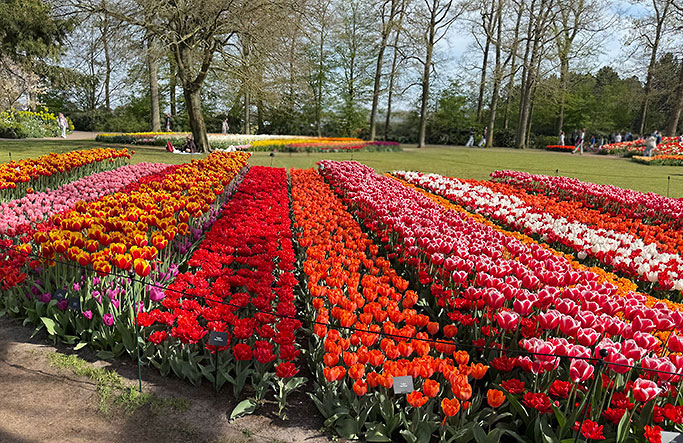
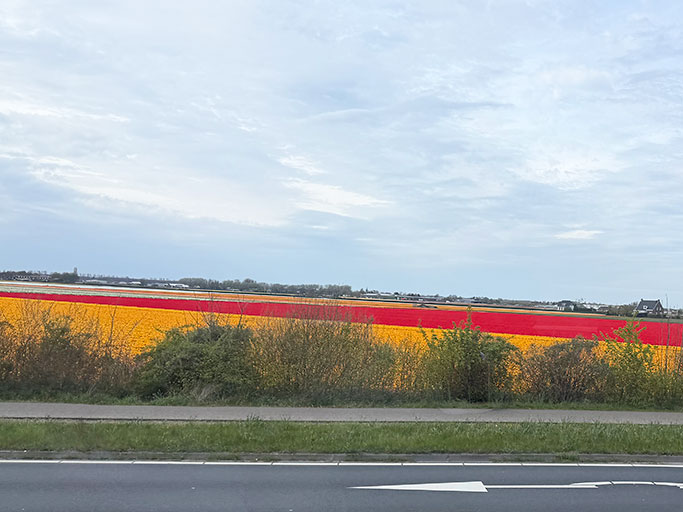
The highlight of the trip was the Keukenhof Gardens!  We arrived by bus and the first thing we saw from the bus was the fields of production tulips, hyacinths, and minor bulbs planted in mass. Think acers of one color of tulips in full bloom! Reds! Yellows! Blue hyacinths! There had to be 150 acres of color!  Fantastic!

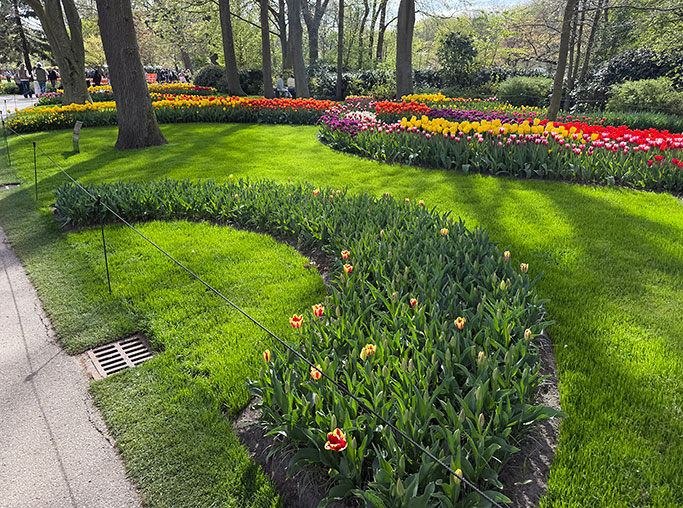
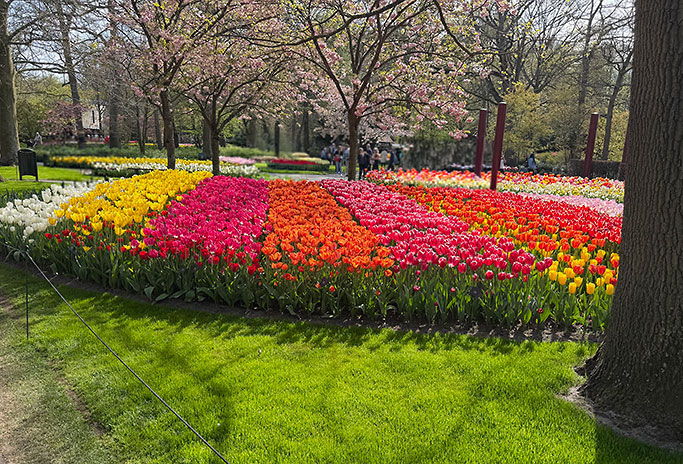
Keukenhof is a park like setting covering 70 acres. Walking paths lead you through bed after bed of color. There are ponds reflecting brilliant color. It is truly a horticultural park where they plant 7 million bulbs annually. There are over 800 varieties of bulbs! I was impressed with a display of blue grape hyacinths planted as a meandering stream of color. It was stunning! 

You've got to go and fill your eyes!

Tim Joy

Behind the Buyer Curtain

Hi! I am Molly and I have been with Christensen’s for 14 years. Many of you may remember me from my days on the perennial lot. These days, I am the perennial buyer, sadly working at a desk (not so sadly during a heat wave or rainstorm). My main goal is to source fresh, quality perennials that are landscape ready!

I wanted to give you a little peek behind the curtain, so that you can understand all that goes into offering the best customer care possible!

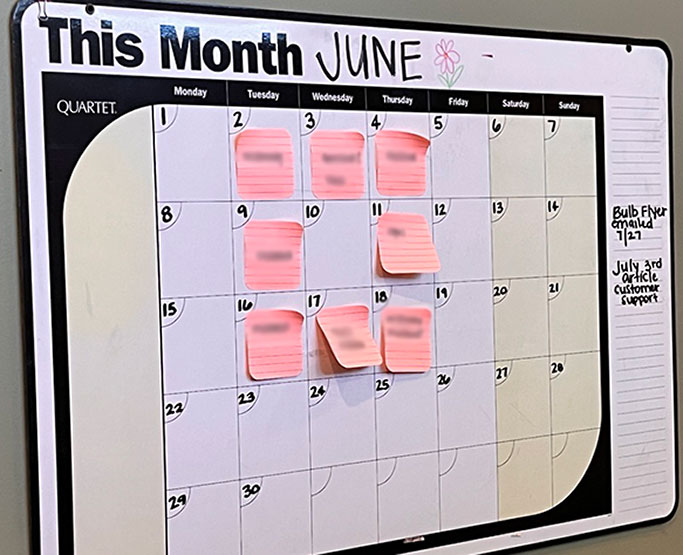
Let me start with the most important aspect of my job: timing. The plant buyers are always working one to two weeks out. For example, today is Monday July 13th. By the end of this week, I will have trucks for the week of July 20th set in stone and am unable to make additions or changes.

This is how I lay out the perennial shipments. Each sticky note represents a shipment, sometimes several. It's necessary for the plant buyers to plan several weeks in advance - not only to source stock material but to plan for

large orders.

You might be wondering, why do I need to know this?? As the contractor, it’s important to understand the lead time required to get your material to Christensen’s. Basically, the buyers need a week or two, sometimes more (depending on time of year) to get you exactly what you need. If you need something ASAP, let us know ASAP so your material arrives fresh and in a timely fashion.

If a project requires a large quantity of a plant, or something funky no one has ever heard of, please let us know, in advance! We want to help! But we order your plant material from all over the country, and with the logistics involved, it takes proper planning on our part.

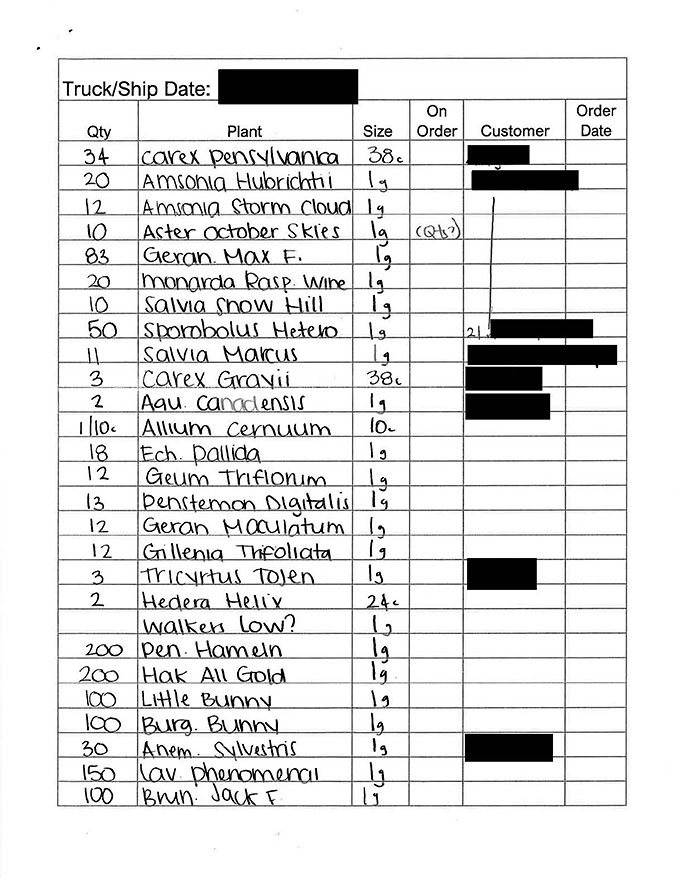
I use this form to keep a running list of what I need to order from a given vendor on a given truck. This list is then emailed to the vendor.


Note that next to the Aster October Skies, I have (Qts?) written. This happens sometimes where you, the customer, ask for a certain size or a specific plant. After checking my sources, I might have to think outside the box and come to you with alternatives.


Flexibility on both sides ensures we get the best possible results for everyone!

There is another snake in the grass to be wary of. Say you give me the list of materials and deposit right on time, I order it for the following week, and all is good. Then the dreaded “bounce back” email arrives, notifying me that the plants are no longer available: crop loss, water issues, pruning issues, someone stole them for another order. Whatever the reason, your plants are not coming as planned.

As a buyer who prides herself on meeting deadlines, this is not an ideal situation for either of us. After follow-ups with your salesperson, who will then notify you of the snag, the plants are added to my “get it here now!” list and your arrival date is pushed back at least another week.

Why am I sharing this bit of information? It’s a gentle reminder that some things are out of our control and many issues can be mitigated with advance planning. For example, after receiving a “bounce back” email, there still might be a chance to meet your deadline because it’s several weeks away.

Finally, advance notice of large or unique orders allows the buyers time to search. Even if you are unsure of the exact date, let us know! I am always putting out feelers to my suppliers, inquiring about finish dates and availability, and am sometimes able to place plants on order for me until we are ready to ship. This will secure your order until you are ready for it! Please know that with special order items, or large quantity shipments, we require a deposit of up to 50%. This lets the buyer know that the order is good. And lets you know, I AM ON IT!

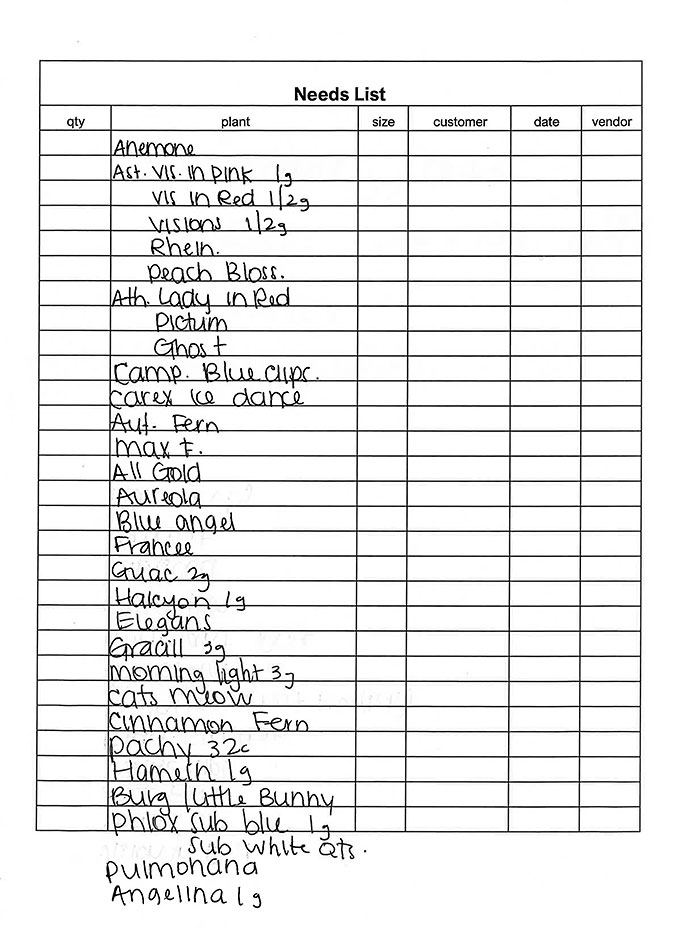
This image is just a sample of how I track needed plants. 

Much of my day is spent looking at "Availability Lists" from our suppliers.

By keeping a "Needs List", items are less likely to get missed. 

Let your sales person know if there's something you need to add to my list. 

The moral of the story is that we, the buyers, are committed to providing you with quality material, in stock when you need it. That quality, however, requires regular turnover. Therefore, we may not have the quantity or item you’re looking for on any given day. Advance notice allows the buyers to work with you to source the material you need when you need it. When situations out of our control pop up, please know that we work hard to make it right.

Thanks for reading, and I look forward to your orders! 😊

Fertilizer Primer

Christensen's offers a full selection of fertilizers for landscape professionals. With so many options available, choosing the right product can sometimes feel overwhelming. Here's a quick guide to help you match common landscape applications with the fertilizer best suited for the job.

Quick Fertilizer Guide

  1. New planting Trees and Shrubs → Bio-Tone Starter Plus + Root Stimulator
  2. Long-term feeding → Osmocote
  3. Acid-loving shrubs → Holly-Tone
  4. Established Trees and Shrubs → Plant-Tone
  5. Flowers → Flower-Tone
  6. Roses → Rose-Tone
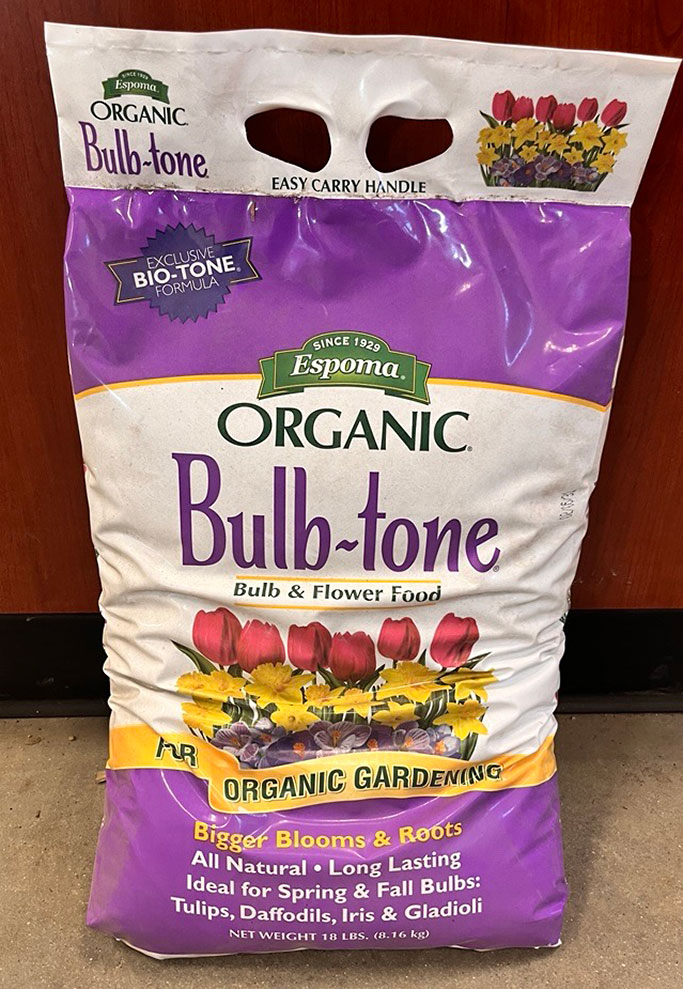
  7. Bulbs → Bulb-Tone
  8. Turf → Milorganite

If you'd like a little more detail, here's a closer look at each fertilizer and where it fits best in the landscape.

Product

 Recommended Use

Bio-Tone Starter Plus

Starter fertilizer for newly installed trees, shrubs, perennials, and annuals. Contains beneficial microbes and encourages strong root development while reducing transplant shock.

General Purpose 12-12-12

A balanced fertilizer for general landscape use. Good for established trees, shrubs, flower beds, and situations where a quick nutrient boost is needed.

Holly-Tone 4-3-4

Formulated for acid-loving plants such as hollies, azaleas, rhododendrons, blueberries, and many evergreens. Helps maintain proper soil pH while feeding.

Plant-Tone 5-3-3

An all-purpose organic fertilizer for trees, shrubs, flowers, and vegetable gardens. Easy recommendation when customers want one product for most landscape plants.

Rose-Tone 4-3-2

Designed for roses and flowering shrubs. Promotes healthy growth and abundant blooms without excessive vegetative growth.

Osmocote Blend 17-5-11

Professional-grade controlled-release fertilizer that feeds for several months. Excellent for trees, shrubs, landscape beds, container plantings, and commercial installations where long-term feeding is desired with fewer site visits.

Flower-Tone 3-4-5

Formulated for annuals, perennials, and flowering plants. Higher phosphorus and potassium support strong flowering and bloom production, helps strengthen root growth.

Fertilizer Stakes 15-7-6

Convenient slow-release feeding for trees and shrubs. Good option when customers want targeted feeding with minimal labor.

Bulb-Tone 3-5-3

Designed for bulbs such as tulips, daffodils, lilies, and alliums. Supports root development and improved flowering.

Milorganite Pro 6-4-0

Slow-release nitrogen fertilizer commonly used on lawns, turf, and landscape beds. Feeds gradually, improves soil health, and has a very low risk of burning plants. Excellent for sod establishment and maintenance.

Ferti-Lome Root Stimulator Plus B-1

Used at planting time to reduce transplant stress and encourage root establishment for trees, shrubs, flowers, and bedding plants.

Application Tips

  • Bio-Tone: Mix into the backfill during planting.
  • Root Stimulator: Water in at planting.
  • Plant-Tone, Holly-Tone, Rose-Tone, and Flower-Tone: Mix into planting beds during installation or apply to the soil surface around established plants and water in.
  • Osmocote: Apply to the soil surface under mulch or lightly incorporate into the root zone.
  • Milorganite: Broadcast over turf and water in.

Christensen's prides itself on partnering with landscape professionals to help them install and maintain beautiful, successful landscapes.

While fertilizer can help plants establish and thrive, more is not always better. Fertilizer is most effective when plants are healthy and actively growing. Avoid fertilizing plants that are drought-stressed or experiencing significant transplant shock. Sites amended with quality compost may also require less fertilizer than expected. In most cases, proper watering, soil preparation, and planting practices will have a greater impact on long-term plant success than fertilizer alone.

America’s Birthday Trivia

My degree is in American history. I was particularly fascinated by the Civil War era as well as how immigrants/emigrants shaped the country.

However, learning lesser known historical facts is always fun for me, no matter the era. Admittedly, my recall abilities aren't very strong. So I'm not necessarily an asset on trivia night. But I love the learning!

As America celebrates its 250th birthday, I thought it would be fun to test your knowledge. Answers are below my byline.

No cheating!!


  1. 1

    True or False. Michigan was a state at the time of the Revolutionary War.

  2. 2
    The land that would become Michigan was part of what Canadian territory at the time of the Revolutionary War?
  3. 3
    Who was on the Committee of Five that drafted the Declaration of Independence?
  4. 4
    What occurred on July 2, 1776?
  5. 5
    True or False. The Declaration of Independence was signed on July 4, 1776.
  6. 6
    How many delegates to the Second Continental Congress signed the Declaration of Independence?
  7. 7
    Did George Washington sign the Declaration of Independence?
  8. 8
    What came first? The start of the American Revolutionary War or the Declaration of Independence?
  9. 9
    What was the final battle of the Revolutionary War?
  10. 10
    What year was the Treaty of Paris signed, ending the American Revolutionary War?
  11. 11
    What European country provided supplies, ammunition and funds to the Continental Army?
  12. 12
    What infection did General Washington inoculate the Continental Army against?
  13. 13
    What was the daily whiskey ration for the Continental soldiers?
  14. 14
    An early copy of the Declaration of Independence was found in a flea market picture frame in 1989. How much was it sold for?

Answers

  1. 1

    False

  2. 2
    Quebec
  3. 3
    Thomas Jefferson, John Adams, Benjamin Franklin, Roger Sherman and Robert Livingston
  4. 4
    The Second Continental Congress officially declared independence from Great Britain. While the Declaration had been written, delegates debated edits for two more days, adopting it on July 4th.?
  5. 5
    False. It wasn’t fully signed until August 2, 1776.
  6. 6
    56
  7. 7
    No. He was away commanding the Continental Army. Neither did other founding fathers such as Alexander Hamilton, John Jay, Patrick Henry, Thomas Paine and Thomas Jefferson.
  8. 8
    The exchange of gunfire at Lexington and Concord in Massachusetts (“the shot heard round the world”) on April 19, 1775 is considered the beginning of the American Revolution, more than a year before the Declaration.
  9. 9
    Battle at Yorktown
  10. 10
    1783
  11. 11
    France. Spain and the Netherlands later joined the war efforts.
  12. 12
    Smallpox. The death by smallpox dropped from 17% to 1%.
  13. 13
    2.5 shots, about 4 ounces
  14. 14
    $8.1 million

Fountain Ponds

As we enter the summer months, and even into fall, why not think of adding something out of the ordinary into the landscape by using a fountain pond? Christensen’s has long been a distributor for EasyPro, based out of Grant, Michigan. This year, we've added products from another Michigan based company, Blue Thumb.

When you've stopped in the Plant Center, you've likely noticed the EasyPro Tranquil Décor Basalt column fountain kit on display. These are normally three columns, with a pump, base, hoses, and normally the lighting that stays in the columns.  EasyPro also offers the Vianti™ Falls Spillway kit, which adds a ‘falls’ system to any block walls that you install. Talk about a great way to add something relaxing to the patio! 

Another option from EasyPro is called Just-A-Falls™. These kits are a simple way of having a beautiful waterfall without the need for a pond.  With the Just-A-Falls™ system, you get everything needed: pump, liner, pipe, glue, pipe, etc.

Blue Thumb offers something a little different with their fountains, ranging from vase fountains, to real stone fountains and even metal fountains.

So far, the metal fountains have intrigued me with shapes like a Japanese maple, a weeping willow and even an Iris flower.

The Iris flower looks to be interesting since the fountain is made from copper and the Iris flower is colored either red or even blue.

While planning for later this year, or even next, keep in mind the option of adding a small, relaxing element into the plan. If I was redoing my patio, I would surely add in a fountain set to relax with after being at work. 

Next time you're at Christensen's, please ask any of us about the fountain pond options from EasyPro and Blue Thumb and we will get you all the information.

Box Tree Moth and The Future

For the past several years, it seems that every new pest or disease affecting boxwood has sparked another round of conversations about removing these iconic shrubs from the landscape. Most recently, the arrival of box tree moth in southeastern Michigan has many homeowners wondering if it is time to replace their boxwoods with something else. In my opinion, the answer is still no. Boxwood has earned its place in our landscapes over decades of performance. Few shrubs can match its year-round color, versatility, deer resistance, and ability to provide structure and formality in the garden. While box tree moth is certainly a challenge, it is a manageable one.

The key is understanding that box tree moth is an insect pest, not a death sentence for every boxwood plant. Like many landscape pests, it can be effectively controlled through regular monitoring and timely treatment. Homeowners and landscape professionals who inspect their plants for feeding damage, webbing, caterpillars, or defoliation can often identify problems before significant damage occurs. Several treatment options have proven effective when applied at the proper time. For example, Btk (Bacillus thuringiensis var. kurstaki) is readily available. The reality is that maintaining healthy boxwoods through monitoring and treatment is often far less disruptive and less expensive than removing mature plantings and starting over.

When considering alternatives, it is important to remember what would be lost. Boxwood has long been the standard for foundation plantings, formal hedges, and landscape accents because few shrubs offer the same combination of size, density, evergreen foliage, and tolerance of pruning. Even Michigan State University Extension, while discussing alternatives, acknowledges that there are currently no perfect replacements that fully replicate the performance and appearance of boxwood. Replacing established shrubs often means waiting years for new plants to reach the same size and visual impact already present in the landscape.

For landscape contractors and homeowners in southeastern Michigan, my recommendation is simple: don't give up on boxwood. Learn to recognize the signs of box tree moth activity, work with a knowledgeable landscape professional, and implement a treatment program when necessary. With proper care, boxwoods can continue to provide the timeless beauty and structure that have made them a landscape favorite for generations. The best boxwood replacement is often the healthy boxwood already growing in your yard.

Air Cured Resin Joint Sand

Installing joint sand on paver projects is crucial for both the structural longevity and lasting aesthetics of the installation. All joint sand fills the gaps between concrete pavers to lock them together, creating a rigid yet flexible surface. It evenly distributes weight, stops pavers from shifting, prevents weed growth and keeps out insects.


Today though, we're tip-toeing into air-cured, resin paver joint sands.


If you’ve been installing pavers for a while, you already know joint sand can make or break a job. It’s the last stage of the project and often the final step before you collect your check.
With polymeric sand, installers must keep a close eye on the weather, temperature, and even ground moisture levels that may keep your concrete pavers too moist on a shady day.

That’s where air-cured resin sands have been gaining traction. From our side of the counter at Christensen’s, we’re seeing more contractors make the switch simply because it takes a lot of the guesswork out of the process. Site prep and scheduling are more straight-forward. Yes, it’s initially more expensive than traditional polymeric. But it’s also more forgiving and less weather-dependent. With resin sand, you’re not racing the clock or watching the weather the same way you are with polymeric. There’s also no chance of polyhaze showing up after the pavers have dried and your crew has left the site.

The big win we keep hearing about is workflow. You can pack up larger equipment, clean your site, and move right into sanding the same day. No scheduling a return trip on a dry day just to finish joints! For companies juggling multiple jobs, this is real time-saver. As the saying goes “Time Is Money

The installation is straightforward. 

  1. Clean the compacted pavers surface, leaving it slightly damp (not flooded)
  2. Sweep or squeegee the sand into the joints with the help of a garden hose.
  3. Sweep off the excess
  4. Lightly mist to settle everything in.

After that, it cures from the top down as the resin becomes exposed to air. No mixing, no polyhaze, and no stressing about a surprise rain shower rolling through right after you leave.

Gator Nitro Joint Sand (stocked at Christensen’s) brings something extra to the table with its semi-permeable setup. It firms up hard and allows water to pass through. This can help with jobs where drainage matters or where permeable specs come into play.

Gator Nitro-X Fine Joint Sand installs the same way as the original Gator Nitro, but features a finer grain, making it a better fit for tighter joints and more refined surfaces. This tighter joint surface encourages water to sheet from your paved area. This may be especially useful near pools where you may grade towards a drain channel.

At the end of the day, resin joint sand isn’t necessarily about replacing every bag of polymeric sand you use. It’s about having another tool that’s a little more foolproof when conditions aren’t perfect or timelines are tight. Resin sand may offer a smoother day on site, and fewer return trips just to deal with joints.

Spring Colors at Christensen’s

Mother Nature can be quite the show-off! She provides us so much beauty in the spring. Christensen's becomes a nature center, with blooming trees, shrubs and perennials creating an amazing cornucopia of color and fragrances to stimulate your senses

Keep scrolling to enjoy a colorful spring photo diary of plants available at Christensen's.

Belle de Nancy Lilac (Syringa vulgaris 'Belle de Nancy') requires full sun for the best blooms. As the flowers open, they have a distinctive white center. Who else believes the scent of lilacs is the best part of spring?

Coralburst® Crabapple (Malus 'Coralcole') is salt-tolerant, grows well in normal, sandy or clay soil and grows to be about 8-12' x 10-15'.

While Malus 'Spring Snow' 

flowers in pure white, this crabapple tree doesn't fruit. At maturity, it can grow to 25' tall with a spread of 22'.

Gladiator™ Crabapple (Malus X Adstringens 'Durleo') not only has these bright pink flowers, its glossy bronze-purple leaves help it to stand out amongst other crabapple trees. This ornamental is advertised as being the perfect choice for space-challenged areas.

Early blooming Frostkiss® Pippa's Purple Hellebore (Helleborus X 'RD9') are a low maintenance perennial providing late-winter, early spring interest to the landscape.

Ivory Prince Hellebore 

(Helleborus 'Walhelivor'), like other Hellebore, is deer and rabbit resistant. Its evergreen foliage provides interest all winter long.

Magnolia stellata 'Royal Star', because it blooms later than other Magnolias, is less susceptible to frost issues. This native of Japan can grow to be 10-20' with a spread of 8-15'. 

Eastern Redbud 

(Cercis canadensis) is known for it's pea-like flowers. They grow best in well-drained soils and can tolerate both full sun and partial shade. This native can grow to a height of 20-30' with a spread of 25-35'.

Cornus florida 'Cherokee Princess' produces these beautiful white flowers in the spring. In late summer, fruit attracts birds. Mature height is 15-30' tall.

Cornus florida 'Cherokee Chief' is known for its spring flowers but also the red of its fall foliage. Growing to 15-30' tall, these dogwoods are pest, drought and deer resistant.

We'll close out the show with the elegant, purple flowers of Roseum Elegans Rhododendron (Rhododendron catawbiense 'Roseum Elegans'). This fast-growing, evergreen shrub thrives in cooler regions like Michigan and is an option as a hedge or privacy screen.

Join us at Christensen's to see what's blooming.

The variety is staggering.

New APP... just for you!

Looking for ways to save time and energy?  You've got to see this exciting new technology - just for you!

1 2 3 56